
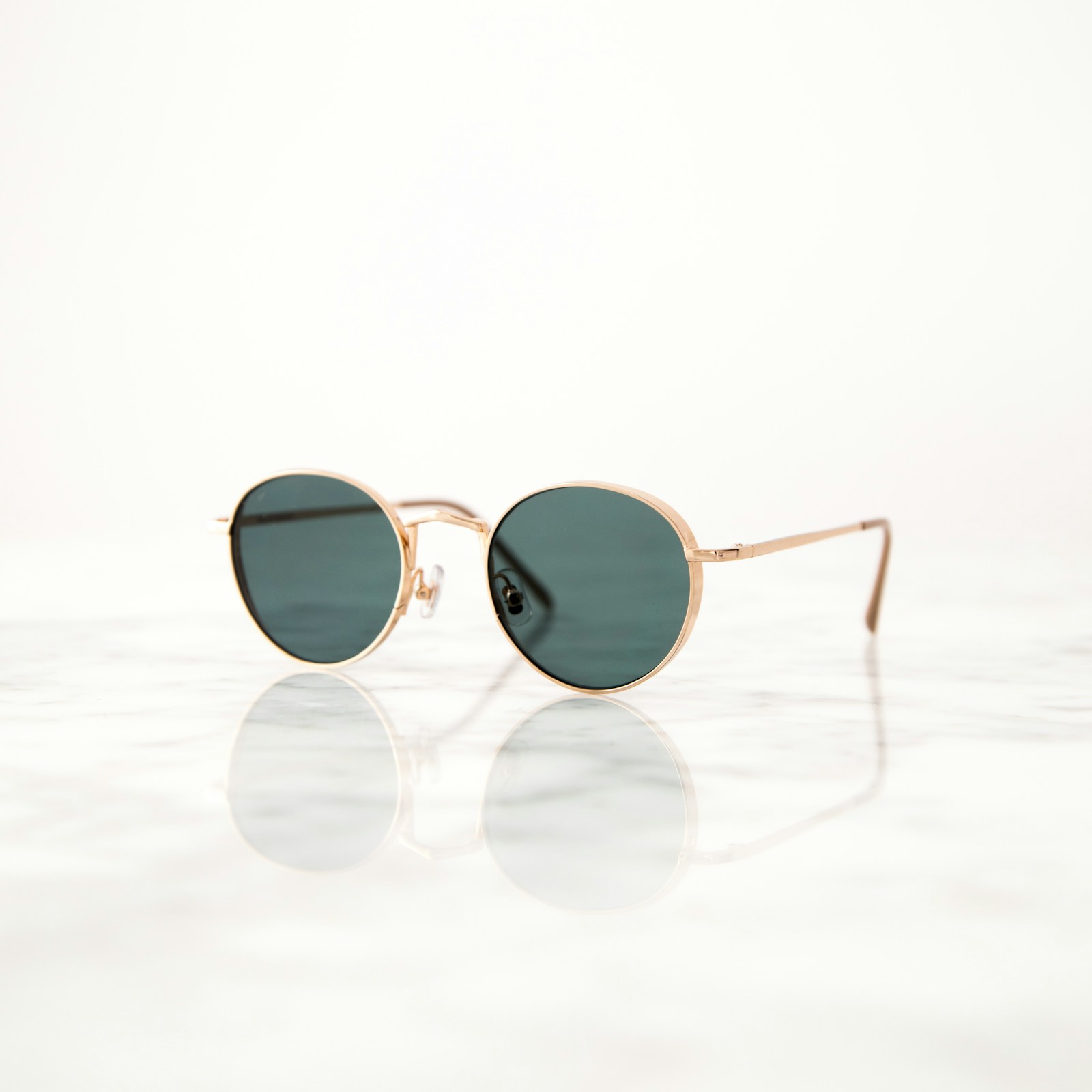
Someone on r/BuyItForLife posted a photo of their Ray-Ban Aviators this week. 21 years old. Same metal frame. Hinges still tight. 5,600+ upvotes and 835 comments of people sharing their own decade-long pairs. The title: “Ray Ban Aviators: 21 Years, Countless Miles, Still Stylish.”
That’s the benchmark. That’s what buy-it-for-life sunglasses look like.
The problem is most sunglasses — even ones you paid $200 for — aren’t built for this. The AR coating peels at year 3. The polycarbonate lens yellows at year 5. The plastic hinge cracks at year 7. You’re back at the store before the decade is out. That’s the cycle sunglass brands live on. Here’s how to break it.
Why Most Sunglasses Fail Within 5 Years
The culprit is almost always the lens. Most sunglasses sold today — including many in the $100-$250 range — use polycarbonate lenses. Polycarbonate is light, impact-resistant, and cheap to make. It’s also not scratch-resistant by nature, which is why manufacturers add AR coatings that eventually peel. UV exposure causes polycarbonate to haze and yellow. The clear lenses at purchase look foggy by year four or five.
Glass lenses don’t do this. Optical glass doesn’t need an AR coating for scratch resistance — it’s inherently harder than polycarbonate. It doesn’t yellow with age. It doesn’t cloud. A glass-lens sunglass maintained normally can look identical in 2046 to how it looks today. The tradeoffs: heavier, and it shatters on hard impact rather than flexing. For daily wear — commuting, driving, hiking — glass wins by a mile.
The second failure mode is frame construction. Cheap metal alloys corrode. Plastic frames crack. Spring hinges lose tension. Barrel hinges on mass-market frames are often held by a single screw that walks out over time. BIFL frames are either solid metal that a local optician can repair, or well-constructed acetate that can be re-polished and adjusted. The test: if the hinge breaks, can you get it fixed at an eyeglass shop? If the answer is no, you don’t own BIFL sunglasses — you own expensive disposable ones.
Randolph Engineering Aviator — $175–$250 (Top Pick)
Made in Milford, Massachusetts since 1978. For over 40 years, Randolph has been the official supplier of sunglasses to the U.S. military — the same frames worn by Air Force pilots, supplied to 25 countries’ armed forces. That’s not marketing. That’s a DoD contract.
The Aviator starts around $175 in nylon lens and runs to $230–$250 for the glass lens versions. Go with glass. The frame is a monel metal alloy — the same corrosion-resistant material used in marine and aerospace applications. Bayonet temples (straight-back, for use with helmets and headgear) are available. Every component is replaceable: screws, temples, nose pads, lenses.
This is the answer to “what do actual pilots wear?” not “what looks like what pilots wear.” The difference in build quality between Randolph and fashion-brand aviators is not subtle once you’ve held both. At $200-$250, they’re the same price as mid-tier Ray-Bans — and they’re built for people whose jobs depend on them not breaking.
Buy them: Randolph Engineering Aviator on Amazon
Ray-Ban Aviator RB3025 with G-15 Glass Lens — $150–$200
The original. Ray-Ban’s G-15 green glass lens was developed for the U.S. Army Air Corps in the 1940s. The formula hasn’t changed much since — it absorbs 85% of available light and provides excellent color balance without distorting reds or blues. It’s optically ground glass. Not polycarbonate. Not “crystal” polycarbonate. Real mineral glass.
When ordering the RB3025, the lens specification matters. The “Classic Green G-15” (~$150-$175) is glass. The “Crystal Brown” and “Crystal Gray Gradient” options are glass. The cheaper, lighter options labeled just “green” or “blue” are polycarbonate. If you’re buying Ray-Bans for a 20-year relationship, you want glass — the same lens the person had who posted that 21-year photo.
The frame is lightweight metal alloy, tear-drop shape, available in 12 sizes. Standard barrel hinges, replaceable at any optical shop on earth. That global service infrastructure is Ray-Ban’s secret weapon. You can be in Tokyo, Nairobi, or São Paulo with a bent hinge, and find someone to fix it. That kind of repairability is worth something.
Buy them: Ray-Ban Aviator RB3025 on Amazon
Costa Del Mar (580G Models) — $180–$300
Costa built their reputation in Florida’s fishing community and they’ve kept it. Their 580G lens is glass, polarized, and engineered around a specific problem: the 580-nanometer wavelength is where harsh yellow-green glare lives. Costa’s 580G glass filters it out, which is why offshore anglers swear by them — you can actually see below the water’s surface. The same contrast enhancement that helps you spot fish in glare makes these exceptional all-purpose glasses in any bright environment.
Models to look at: the Blackfin ($180-$220), the Fathom ($200-$250), the Permit ($200-$250), the Hamlin ($200-$270). All available in 580G glass. Costa also sells replacement 580G lenses separately, so when a frame wears out, you’re not replacing everything. Their frames are nylon/bio-resin — not metal, so they’re lighter but less indefinitely repairable than Randolph. BIFL on the optics; good on the chassis.
Buy them: Costa Del Mar 580G on Amazon
Persol 714 — $250–$350
Italian. The folding frame Steve McQueen wore in The Thomas Crown Affair (1968). Persol’s patented “Meflecto” spring-hinge system lets the frame flex without breaking — a more sophisticated mechanism than the standard barrel hinge. The lens is mineral glass, optically ground in Italy. The frame is acetate, which can be re-polished, adjusted, and repaired by any skilled optician.
The 714 runs $250-$350 depending on colorway and lens option. It’s the most expensive pick here, and the logic is different: because it folds flat into your pocket, you’re more likely to actually take it everywhere — which means you’ll wear it more, and you won’t leave it behind or toss it casually somewhere it’ll get sat on. The sunglasses most likely to break are the ones you’re cavalier with. The folding mechanism fixes that.
Persol covers the 714 with a 2-year warranty. After that, it’s repairability that keeps them alive — and Italian-made acetate frames are something any experienced optician can work on.
Buy them: Persol 714 on Amazon
Maui Jim — $150–$350 (Good, But Not True BIFL)
Maui Jim’s PolarizedPlus2 lens blocks 100% of UV and uses a 5-layer polarization system that genuinely improves color saturation — reds are redder, blues are deeper. If you spend a lot of time in bright outdoor environments, the visual difference is real. They offer glass and polycarbonate versions; the glass options are the ones worth buying for longevity.
The problem: 2-year warranty covering manufacturing defects only, and no lens exchange program that matches Costa’s. Maui Jim does offer paid repair and replacement services after warranty, so they’re not unserviceable. But at $200-$350, you’re paying a premium for optics, not for BIFL construction engineering. Get the glass version if you’re buying Maui Jim. Skip the polycarbonate entirely.
Buy them: Maui Jim glass lens sunglasses on Amazon
What to Skip
Oakley ($100-$250): Excellent sport eyewear — the Prizm lens technology is genuinely useful for specific activities (skiing, cycling, golf). But Oakley uses polycarbonate as standard across their line. For BIFL, that’s a dealbreaker. Their lifetime guarantee covers manufacturing defects, not normal lens wear. If you’re doing contact sports, buy Oakley for the impact resistance. For a 20-year daily driver, look elsewhere.
Warby Parker ($95-$175): Great company, makes prescription glasses accessible, not a BIFL sunglass brand. Polycarbonate lenses, 1-year warranty, trend-driven designs that cycle every season. Buy them for backup pairs or prescription readers. Don’t buy them expecting 15 years of use.
Bombas of sunglasses (various): Any heavily-marketed $150+ sunglass with polycarbonate lenses and a social-media-first brand story. The Bombas backlash thread on r/BuyItForLife this week (5,618 upvotes, 835 comments) wasn’t specifically about sunglasses — but the same principle applies. High marketing spend, middling construction. The community noticed with socks. The same logic applies to eyewear.
The Honest Part: No Sunglass Brand Offers a Forever Guarantee
Darn Tough will replace your socks forever, no questions asked. No sunglass company does this for lenses — and reasonably so, because glass lenses can be broken through user error. What BIFL sunglasses actually provide is repairability: the ability to replace screws, temples, lenses, nose pads over a decade or two of use. Metal frames that can be soldered. Glass lenses that can be swapped without replacing the whole frame. Construction that a local optician can work on.
The r/BuyItForLife community verdict across multiple threads: Randolph Engineering for the hardcore BIFL answer. Ray-Ban G-15 glass for the practical BIFL answer. Both are right. Both are in the same price range. The difference is that Randolph was engineered to the spec of a DoD contract, and Ray-Ban was engineered to a fashion spec that happened to also be very good.
The Math
Cheap $40 polycarbonate sunglasses replaced every 3 years = $267 over 20 years, plus 7 trips to the store and 7 pairs in a landfill. A pair of Randolph Aviators at $220 = $220 over 20 years. Not complicated. This is the same math that makes BIFL watches and quality leather boots the obvious choice once you run the numbers.
Bottom Line
- Best overall: Randolph Engineering Aviator ($175-$250) — military-grade, glass lens, made in USA, every component replaceable
- Best icon/practical pick: Ray-Ban RB3025 with G-15 glass lens ($150-$200) — 21 years and counting, global service, the real classic
- Best for outdoors/water: Costa Del Mar 580G ($180-$300) — best polarized glass lens available, anglers have trusted them for 40 years
- Best heritage/foldable: Persol 714 ($250-$350) — Italian glass, spring hinge, goes anywhere with you
- One rule for all of them: Glass lens. Never polycarbonate if you’re buying for life.