
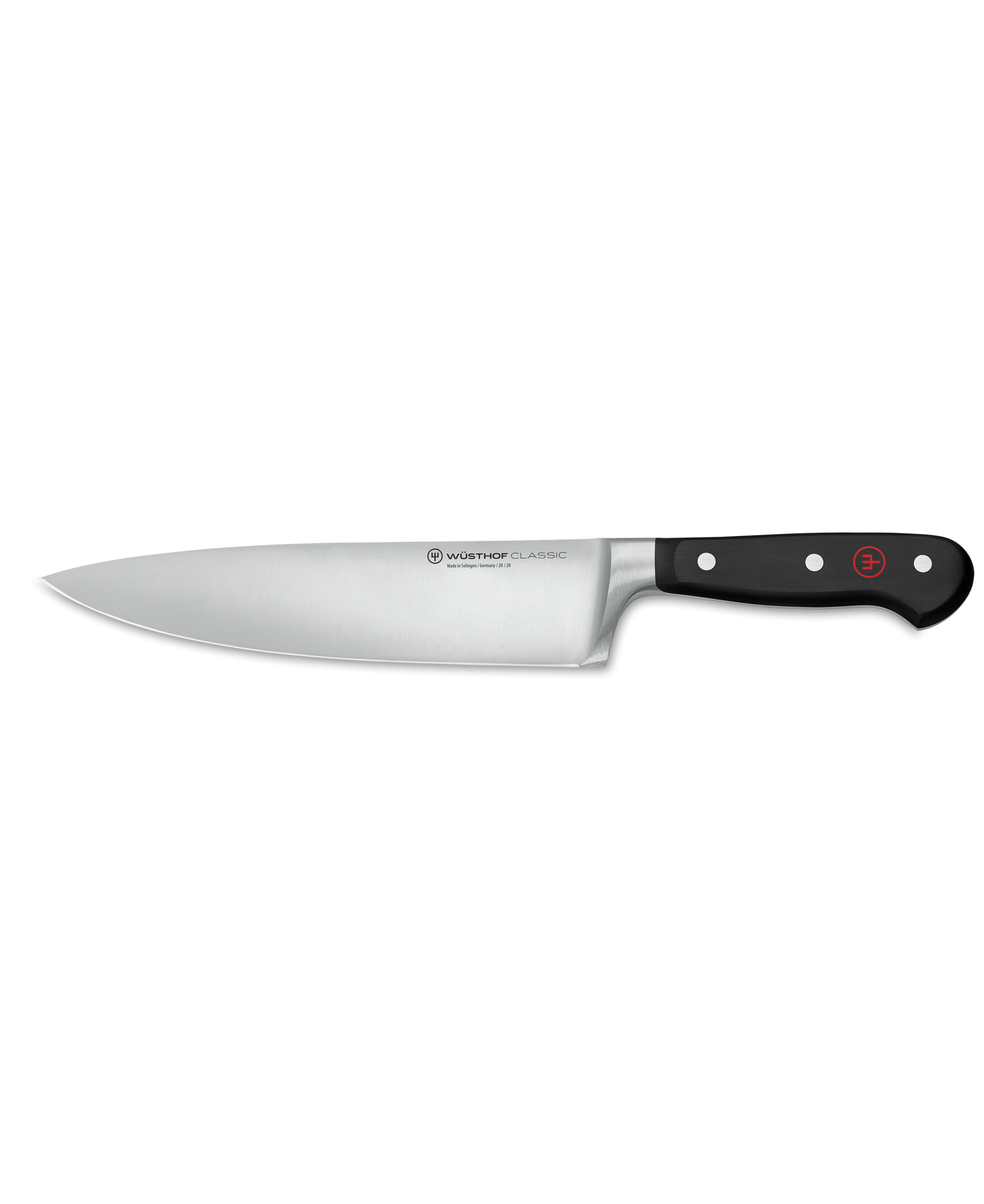
If you want the best chef knife for life, buy the one you’ll actually maintain. My blunt ranking is simple: the Victorinox Fibrox Pro 8-inch is the smartest buy at about $46, Wüsthof Classic 8-inch is the heirloom pick at $170, Tojiro DP F-808 is the best cheap Japanese option, MAC MTH-80 is the sweet spot for serious cooks, and Shun Classic DM0706 is the prettiest knife here if you care enough about free sharpening to pay for it.
The real buy-it-for-life question is not “which knife is fancy?” It is “which knife can I keep sharp for 30 years without hating my life?” That is why the chef knife matters more than almost any other kitchen tool. If you pair it with a decent cutting board and a bread knife, the rest of your kitchen gets easier fast. See also: The Best Buy-It-For-Life Cutting Board, Best Buy-It-For-Life Bread Knife, and Best Buy-It-For-Life Kitchen Shears.
What actually makes a chef knife last
Most chef knives die for boring reasons. The blade is fine. The handle loosens. The edge gets abused. Somebody runs it through the dishwasher until the handle looks tired and the edge feels like a butter knife. That is not a knife problem. That is a user problem.
The parts that matter are simple: steel quality, tang, edge angle, and whether the handle survives wet hands and daily use. A forged German knife like the Wüsthof Classic is built thick, balanced, and forgiving. Wüsthof says the 8-inch Classic is forged in Solingen, Germany, runs at 58 HRC, and uses a standard 14-degree-per-side edge. It costs $170 on the official site, which is not cheap, but it is the kind of knife that can outlive a bunch of cookware sets and still feel normal in your hand. Wüsthof’s product page is very clear about what it is selling: a hand-wash-only workhorse, not a delicate showpiece.
Japanese-style knives usually go thinner and harder. That gives you a better edge and a cleaner cut, but it also means you stop pretending the knife is a pry bar. Twisting through a carrot or hacking at bone will chip a Japanese blade faster than a German one. That tradeoff is why I keep both styles in the mix.
Best buy-it-for-life chef knives right now
Victorinox Fibrox Pro 8-inch: best value, period
At about $46, the Victorinox Fibrox Pro is the knife I recommend to people who want one good knife and do not want a lecture. Food & Wine named it the best value chef knife of 2026 at that price, and the praise makes sense. It is light, easy to sharpen, and honest. The handle is plain, the blade is stamped instead of forged, and none of that matters when you are breaking down onions, herbs, carrots, or chicken thighs every day.
This is the knife I would hand to a friend who is just getting serious about cooking and does not want to spend Wüsthof money yet. The Fibrox handle is grippy, which sounds boring until you have wet hands and a wet countertop. It is not the sexiest knife in the drawer. It is the one that makes the drawer work.
Food & Wine’s 2026 chef-knife guide puts it exactly where it belongs: best value, no drama.
Victorinox Fibrox Pro 8-inch on Amazon
Wüsthof Classic 8-inch: best German heirloom
If you want one knife that feels like it was made to stay in the family, buy the Wüsthof Classic. It is forged in Germany, weighs like a real tool, and feels stable instead of twitchy. The current official price is $170, which is not bargain territory, but Wüsthof backs that price with the kind of build quality that still matters after the warranty card gets lost in a drawer.
The official product page says the knife is hand-wash only, has a 58 HRC blade, and is built for mincing, chopping, cutting meat, fish, fruit, and vegetables. That is the whole job description of a chef knife, and Wüsthof is good at it. If you want a blade that forgives sloppy technique better than a harder Japanese knife, this is the one.
Wüsthof also makes the case for itself in the customer reviews. Plenty of buyers talk about replacing knives that lasted decades. That is the point. You are not buying a disposable tool with a premium label. You are buying something that should survive the way real home cooks use knives: every day, a little care, occasional sharpening, zero nonsense.
Wüsthof Classic 8-inch on Amazon
Tojiro DP F-808: best cheap Japanese knife
The Tojiro DP F-808 is the one people bring up when they want Japanese sharpness without paying Shun money. Expect roughly $100 depending on the seller. The big reason to buy it is the steel: a VG-10 core, three-layer construction, and the kind of edge that makes prep feel easier than it should at this price.
This is a knife for people who actually want to learn how to use a whetstone. If you are willing to maintain it properly, it rewards you with a cleaner cut and less food sticking than most heavy German knives. If you are the kind of person who wants to toss a knife in the sink and forget it, skip it. That is how you chip a Japanese blade and then complain that Japanese knives are fragile.
Tojiro is the best answer to the question, “What if I want a serious chef knife but refuse to cross the $150 line?” That is a real search query, not a hypothetical one.
MAC MTH-80: best for serious home cooks
Food & Wine puts the MAC Professional 8-inch Hollow Edge at $175, and that is about where it lives. The MAC is what happens when you want Japanese edge quality, but you do not want a knife that feels precious. It is lighter than the Wüsthof, cuts cleaner than most Western blades, and has that hollow-edge design that helps food release a little more easily.
This is the knife for somebody who cooks a lot and wants a blade that feels more agile than the Wüsthof. It is not the cheapest option, and it is not the most forgiving one, but it is probably the best compromise for cooks who know they will sharpen their own knives and want something that stays pleasant to use year after year.
If the Victorinox is the smart buy and the Wüsthof is the heirloom buy, the MAC is the “I actually cook every week and I can feel the difference” buy.
Shun Classic DM0706: best if you want free sharpening
The Shun Classic 8-inch chef knife is expensive, usually somewhere around $165 to $185, but Shun has one thing most brands do not: free sharpening for the life of the knife. That is not a gimmick. If you actually send the knife in, the math gets better over time.
Shun’s current official material is all about authenticity, counterfeits, and the fact that every knife carries a model number like DM0706. The important part for a BIFL buyer is that the company is serious about support and service. Shun knives are handcrafted in Japan, and the brand has built its reputation on sharp, lightweight blades that hold their edge well. The free sharpening service makes a very real difference for people who do not want to learn sharpening on day one.
The downside is obvious: this is the knife most likely to get babied because it looks too nice to abuse. That is not a reason to buy it, but it is worth admitting. If you like the feel of a premium Japanese knife and you want the company to help with maintenance, Shun is the most complete package.
What not to buy
- Cheap block sets: You will use three knives. Maybe four. The rest is drawer clutter.
- Dishwasher use: Heat, moisture, detergent, and vibration are all bad for edges and handles. Hand wash and dry the knife.
- Pull-through sharpeners on expensive knives: Fine for a cheap backup knife. Bad news on a $170 Wüsthof or a Japanese blade you care about.
- “I need a giant knife”: Most home cooks do better with an 8-inch chef knife than with a 10-inch slab that feels like kitchen cosplay.
How to keep one alive
A chef knife lasts because you keep the edge alive. That is the job. The maintenance is not complicated:
- Use a wood or plastic cutting board, not glass, stone, or bamboo that feels like concrete.
- Hone German knives regularly. A Wüsthof wants attention, not panic.
- Use a whetstone for Japanese knives and stop pretending a honing rod fixes everything.
- Store the knife in a block, on a magnetic strip, or in a sheath. Stop tossing it in a drawer.
- Sharpen before the blade gets truly dull. Dull knives are harder to control.
That is the real BIFL trick. The knife is not magical. The maintenance is just low enough that normal people can keep up if they care.
The verdict
Buy the Victorinox Fibrox Pro if you want the highest-value chef knife on the market and you would rather spend the rest of your budget on food, a good cutting board, or literally anything else.
Buy the Wüsthof Classic if you want the best German chef knife and you are happy paying for weight, balance, and a blade that feels like a forever tool.
Buy the Tojiro DP F-808 if you want the cheapest serious Japanese knife that still feels grown-up.
Buy the MAC MTH-80 if you cook enough to notice edge feel and food release.
Buy the Shun Classic if free sharpening and a premium Japanese feel are worth the extra cash.
My actual recommendation is boring and correct: Victorinox first, Wüsthof second. That is the answer for most people. If you want the nicer knife and you know you will maintain it, buy the Wüsthof and stop thinking about chef knives for a decade.
Related reads: The Best Buy-It-For-Life Cutting Board, Best Buy-It-For-Life Bread Knife, and Best Buy-It-For-Life Kitchen Shears.